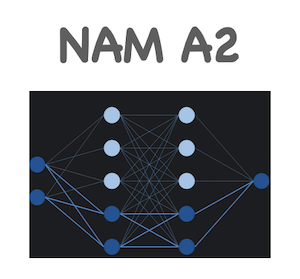
Steve Atkinson presented the results of his research on a new architecture for NAM on December 7th in San Diego at a workshop during the NeurIPS conference (Neural Information Processing Systems Conference), on the theme “Where Creativity Meets Computation.”
Steve worked on a new architecture for NAM that allows for the “calibration”—or definition—of the CPU consumption level—and likely the memory consumption level—required to run NAM models after model training. This involves configuring the complexity/fidelity level at model loading and is named “slimmable NAM” by Steve.
Based on the observation that there are currently no affordable or budget-friendly hardware NAM players available for standard models, and that the affordable NAM players (Valeton, Hotone, Nux, etc.) all use proprietary approaches, Steve decided to propose a more universal and standardized solution that could be adopted by various hardware vendors in the future.
In order to run models on hardware with limited CPU resources, today, it’s necessary to either use proprietary conversion (as with the multi-effects mentioned above) or create simplified, less resource-intensive models (such as the NANO, FEATHER, and LITE models). This requires several different training programs (one per architecture) and also involves stacking numerous model versions. For more information on this topic, you can consult the second article in my NAM series here: https://overdriven.fr/overdriven/index.php/2025/08/12/using-nam-part-2/.
Similar to IR loaders that truncate an IR to the format supported by the player (512 points, 1024 points, 2048 points, etc.) and allow the hardware to limit the complexity of the operations required for IR rendering (particularly CPU usage, but also the memory and storage space for the IR itself), the future “A2” architecture should allow for a similar approach for NAM models: starting with a “standard” A2 model, the hardware will be able to select a fidelity level—and therefore a CPU usage level—during loading, and perhaps dynamically. This could open up scenarios where conversions become unnecessary and the hardware could potentially support multiple fidelity/cost levels. Imagine a scenario where a multi-effects unit could offer support for the standard model (or any other “maximum” quality relative to the CPU used) but then impose a limit on the number of additional blocks. By selecting a “lite” option on your NAM model, the hardware would allow you to use more effect blocks….or multiple NAM models…
Steve’s idea is to propose this approach to the community and see how it reacts. Something to keep an eye on in the coming months.
See the original announcement article on the Neural Amp Modeler blog: https://www.neuralampmodeler.com/post/introducing-slimmable-nam-neural-amp-models-with-adjustable-runtime-computational-cost
Also, please check the NAM models page here for NAM models download links and other NAM-related blog posts.
Leave a Reply