Originally announced for September 2025, version 2.0 of the Kemper profiling system, usable on the MKII hardware versions launched last year, was finally released in beta a few weeks ago. And I’ve finally been able to spend some time exploring and testing this version by capturing profiles on 4 – 5 amplifiers… In this post, I’ll share my first impressions…
The Kemper R&D team certainly had to put in a lot of effort for this major update to their capture system, as the specifications and the equation were quite complex. Indeed, they had to make up for all or part of the “lag” they had fallen behind the competition in terms of fidelity over the last two to three years (think Quad Cortex, Tonex, and NAM), simplify and make the capture process more robust, while maintaining a system compatible with all parameters and the existing ecosystem (Kemper cab and Kone mode), and all while retaining the ability to use the new profiles on the older hardware range, designed and launched in… 2012… Mission accomplished?
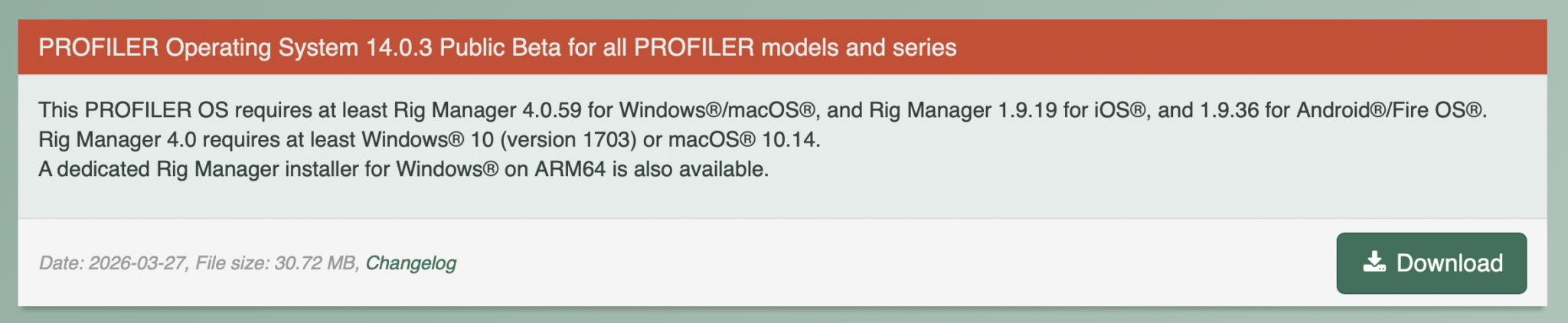
After downloading and installing Rig Manager beta and OS 14.0.3 – operations completed in a few minutes – the system restarts and retains the same operating mode as before. From an interface perspective, the changes are very subtle, and regular users won’t notice any major alterations. New options appear here and there, but overall, the experience remains the same as with previous versions of Rig Manager. Note: obviously, to capture and use 2.0 captures in full resolution, you will need MKII hardware or a Kemper Player.
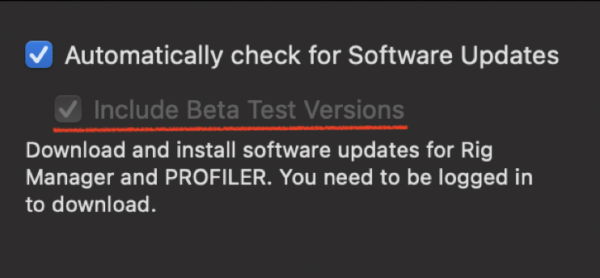
To install this version, you can manually download the OS for upgrade via USB drive, or you can enable beta support in RigManager, which will download RigManager itself and the firmware for you, and perform the installation via USB cable connection.
To enable beta versions, check the option in RigManager preferences:
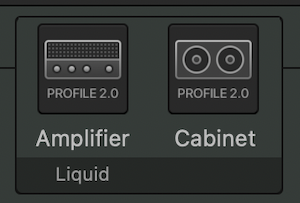
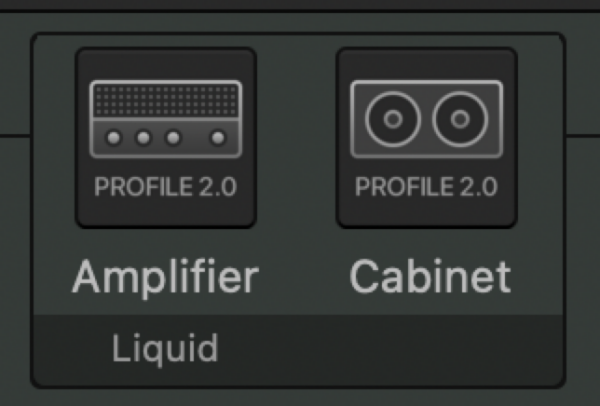
The main new features are present on the amp and cab blocks – which can now bear a “2.0” label – and during the capture procedure in which you can now choose to create a “2.0” profile or a classic profile.
The capture procedure to be used can now be selected:
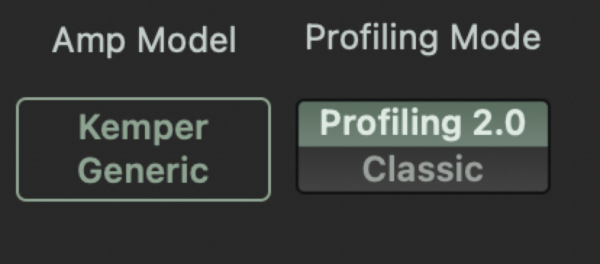
This new procedure is fully automatic (there is no “refine” option), very short (1 minute flat), and runs entirely locally (no cloud access required, no processing phase). In the sixty or so tests I performed, it seemed to me to be more robust than the previous procedure (i.e., less sensitive to level settings and signals with a lot of noise or hiss).
The amp section itself is unchanged: all the existing parameters are there and function similarly to previous versions, with the option to use Liquid Profiling (using tone stacks corresponding to amp models). The profiling approaches are also maintained: you can still capture and use full rig profiles, direct amp profiles (i.e., your amp’s cab output brought down to line level*), and combined profiles that combine the two previous types (Merged profiles). The Liquid Profiling option is, of course, still available.
(*) Important – as a reminder – you must use a load box to obtain this type of signal from the output of a tube amplifier: never connect this type of output directly to a sound card, or you risk damaging your equipment.
On the cab section, two parameters appear: Reso freq., which represents the resonant frequency of the captured cab, and Reso. Intensity, which allows you to adjust its level. These two additional parameters affect the reproduction of the low end of the spectrum and allow you to adjust the cab’s low-end, in addition to the existing parameters.
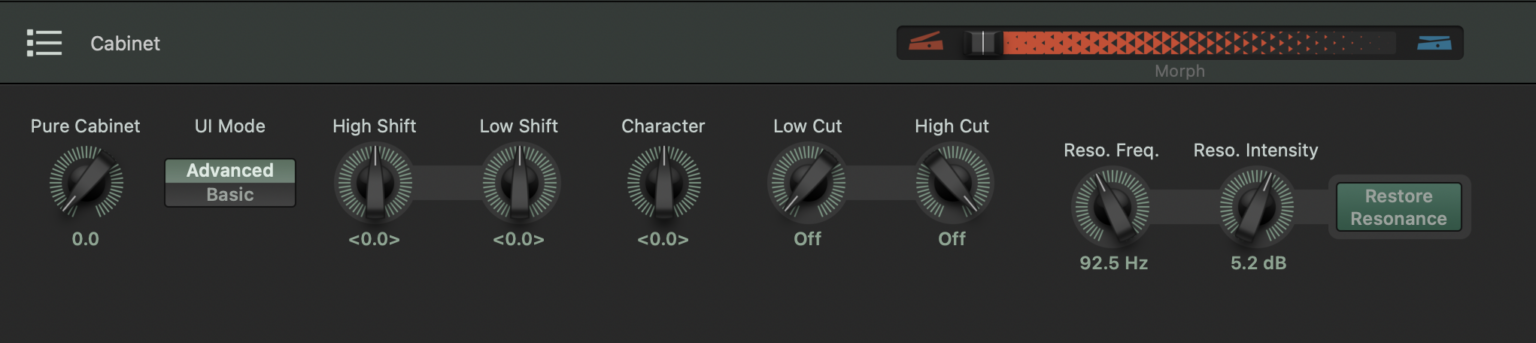
So I captured MKII profiles with my own gear (amps, cabs, microphones) , that I had already tested in previous recordings with the first gen Kemper, this time using MKII gear, in clean, crunch, and high-gain settings. The verdict? The results are significantly better, and the fidelity to the original seems considerably higher: in the A/B comparisons that can be done at the end of the capture procedure and in the majority of the tests I performed, it seemed difficult to discern any differences, and the “Kemper sound” (emphasis on mids and compression) now seems absent or very significantly attenuated. The overall impression is of a more faithful and neutral sound, with a bass register that seems much better reproduced, more open and clearer, with less compression. On some amp models, there may be some differences in resonance or clarity, and you may sometimes need to slightly adjust the gain and/or presence levels, but overall, the results are much closer to the original.
For your information and to conduct your own tests, you can download these MKII models from RigManager: they are models based on Deliverance and Pittbull amplifiers with EL34 power sections, a Dual Rectifier, and a 6505. The cabinets used are: 1×12 12-65, 2×12 FatBoy Governor, 2×12 Recto V30, and 4×12 V30. The Dual Rectifier and 6505 models were recorded in Liquid Profiles mode.
The microphones used are SM-57s and an LD-103. You can filter the search in Rig Exchange by using the “Overdriven” to find them quickly.
In the end, this major update for Kemper is a great success and, in my opinion, reignites interest in the Kemper ecosystem. In my view, it uniquely combines a profiling approach with a comprehensive set of parameters to tailor the resulting sound to your individual needs and your context, along with very high-quality effects.
Below, I also recommend a video from Tone Junkie, which demonstrates the differences in sound quality for the same amplifier between the MKI and MKII profiles across both generations of equipment: https://www.youtube.com/watch?v=rM9-_0VrVIg
David
Leave a Reply